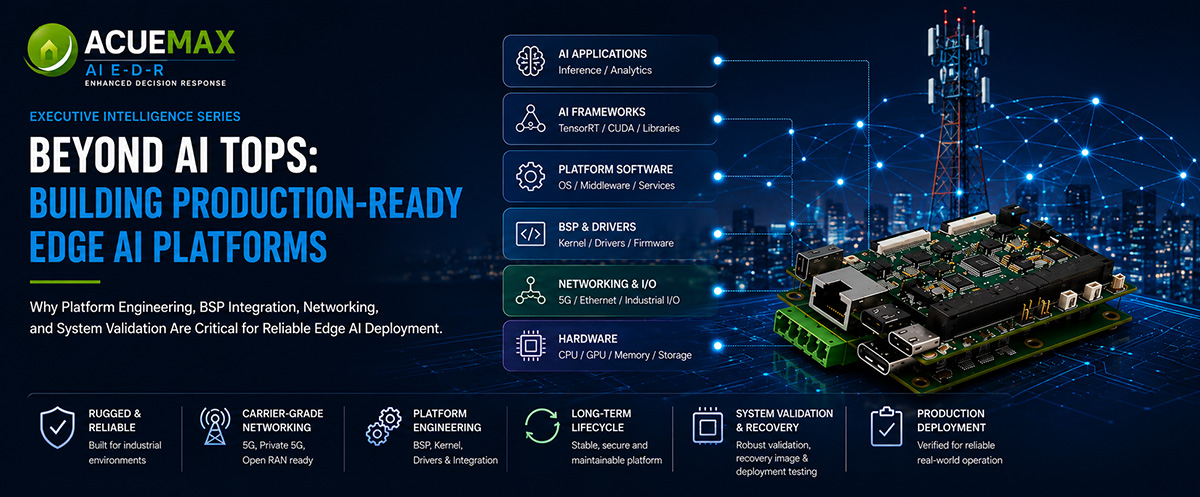
Beyond AI TOPS: Building Production-Ready Edge AI Platforms
Artificial Intelligence has transformed how organizations evaluate Edge Computing platforms. Discussions often begin with AI TOPS, GPU architecture, memory bandwidth, camera interfaces, benchmark performance, and inference speed. These metrics are important, but they describe only the visible portion of an industrial AI system.
As Edge AI moves from laboratory demonstrations into long-term industrial infrastructure, a different challenge becomes clear: many projects do not fail because the AI processor lacks performance. They fail because the platform surrounding the processor was never engineered for production deployment.
The Real Engineering Challenge
A modern NVIDIA® Jetson™ platform is only one component within a much larger engineering ecosystem. Successful deployment depends on software and hardware layers that must work together and evolve throughout the product lifecycle.
Key platform layers include:
- Board Support Package (BSP)
- Linux Kernel and Device Tree configuration
- Driver integration and industrial I/O enablement
- Network protocol support
- Recovery image management
- Software lifecycle maintenance and security updates
- Long-term platform validation
These layers determine whether an AI system remains reliable after deployment—not simply whether it boots successfully in a development environment.
The Hidden Boundary Between Prototype and Production
Most AI proof-of-concept projects can demonstrate that the model runs and the hardware provides sufficient compute. The greater engineering challenge begins after that validation.
Production teams must answer questions that benchmark reports rarely address:
- Can the platform migrate to a future JetPack release?
- Will existing drivers remain compatible?
- Can industrial peripherals continue operating correctly?
- Can additional networking protocols be enabled without compromising system stability?
- How are recovery images maintained?
- How is software updated throughout a ten-year product lifecycle?
These issues often determine whether an Edge AI project can move from prototype to production.
A Platform Engineering Framework
Production Edge AI should be approached as an engineering discipline rather than a hardware selection exercise. A structured methodology connects platform engineering, BSP foundation, kernel enablement, driver integration, industrial interface support, protocol enablement, system validation, and deployment confidence.
Each layer contributes directly to system stability, software maintainability, deployment confidence, and long-term lifecycle support.
Engineering Case Example: Extending Capability Without Sacrificing Stability
A recent engineering project required an Edge AI platform to support a carrier-grade networking workload beyond its original software configuration. The objective was broader than simply enabling an additional Linux protocol: the platform needed to extend networking capability while preserving overall system stability.
The engineering activities included:
- BSP integration
- Linux kernel configuration
- Driver compatibility verification
- Platform image generation
- System validation
- Recovery image preparation
- Production deployment testing
The goal was not merely feature enablement. It was preserving deployment reliability while expanding platform capability.
Why Carrier-Grade Networking Matters
Modern Edge AI increasingly operates alongside communications infrastructure. Applications in 5G infrastructure, Open RAN, Private 5G, industrial edge computing, intelligent transportation, and mission-critical communications often require telecom-grade networking capabilities.
Carrier-grade workloads can require redundant communication paths, high availability, multi-interface networking, reliable session continuity, and deterministic communication behavior. These capabilities depend on deep integration between the Linux kernel, BSP, device drivers, networking stack, and industrial applications.
Supporting these workloads is therefore a platform engineering challenge—not a simple software installation task.
From AI Compute to Industrial Infrastructure
In a production deployment, AI inference occupies only one layer of a much larger ecosystem. Industrial equipment and sensors feed high-speed interfaces; platform engineering connects Linux, the networking stack, CUDA, TensorRT, and AI models; the resulting decision engine then drives the industrial response.
This architecture shows why raw compute performance alone cannot define deployment readiness. The surrounding platform must be engineered as a complete system.
Industry Implications
Organizations investing in Edge AI increasingly need platforms capable of supporting evolving software environments, including new Linux releases, future JetPack versions, additional industrial interfaces, carrier-grade networking, recovery management, cybersecurity updates, and long-term maintenance.
For this reason, platform evaluation should extend beyond AI performance and consider the engineering capability required to maintain and validate the complete system over years of deployment.
The ACUEMAX Engineering Approach
ACUEMAX views NVIDIA Jetson platforms as the foundation of complete Edge AI infrastructure rather than standalone computing modules. Our engineering focus includes platform architecture, BSP engineering, kernel integration, driver validation, industrial I/O, networking enablement, lifecycle management, and deployment validation.
The objective is not simply to build faster AI platforms. It is to enable platforms that continue operating reliably throughout years of industrial deployment.
Executive Judgment
Carrier-grade Edge AI requires more than protocol support. It requires platform engineering that preserves system stability while enabling new capabilities across the entire software stack.
Performance attracts attention. Platform engineering earns long-term trust.